$
$ Search




 ,
,




Electric valve automation is worth considering when compressed air is not readily available at the valve location, extending it is too expensive, it is unreliable, or more than the application requires.
While compressed air is common in many industrial plants, it does not mean plant air is available everywhere it is needed. Running air lines to a remote valve, outdoor installation, utility area, or OEM skid can add cost and complexity.
That is where electric actuators can offer a practical alternative. The important question to ask is: what does the application actually need?
Compressed Air is Not Free
Many facilities treat compressed air as inexpensive since it is already available. That is not always accurate.
Compressed air is an on-site generated utility. It requires compressors, dryers, filters, piping, valves, regulators, and maintenance. The U.S. Department of Energy has reported that compressed air generation can account for approximately 10% of a typical industrial facility’s electricity consumption. In some facilities, it may account for 30% or more. DOE also notes that compressed air is one of the most expensive energy sources in a plant. (Source)
However, using plant air for every automated valve can create hidden costs, especially when only simple open/close valve operation is required.
Those costs may include:
- Extending air lines to remote valve locations
- Adding air preparation equipment
- Maintaining air dryers and filters
- Fixing leaks in compressed air piping
- Managing pressure drops
- Installing solenoid valves and accessories
- Troubleshooting air quality issues
- Supporting compressor capacity for added demand
For one valve, those costs may seem minor. Across multiple valves or a distributed system, they can add up quickly.
Where Electric Valve Automation Deserves a Closer Look
Electric valve automation becomes attractive when the application does not need the speed or fail-safe characteristics of pneumatic actuation.
Many valves only need to open or close at specific times. Others need modulating control but do not require compressed air. Some valves are installed in locations where power is available, but air is not.
Electric actuators may be a better fit when:
- Plant air is not available near the valve
- Extending air lines would be costly
- The valve cycles only occasionally
- Electric power is easier to access than compressed air
- The system needs a simpler installation
- Air leaks are a concern
- The application requires position feedback
- The valve is part of an OEM skid or packaged system
- The valve is in a remote or outdoor location
Electric actuation can reduce the need for air tubing, air preparation equipment, solenoids, and pneumatic accessories. It can also simplify installation when the control system already supports electrical wiring.
How Electric Actuators Can Simplify Valve Automation
One of the biggest advantages of electric valve automation is system simplicity.
A pneumatic valve package often requires more than the actuator. It may also require air tubing, fittings, solenoid valves, regulators, filters, dryers, and other air-preparation components. Those components add cost, installation time, and maintenance requirements.
An electric actuator can reduce that complexity.
In many applications, the actuator only needs power and control wiring. That can be easier to manage when the valve is located near an electrical panel, a PLC, a skid control system, or a remote monitoring station.
Electric actuators can also simplify control integration. Depending on the actuator and options selected, they can support:
- Open/close control
- Modulating control
- Position feedback
- Auxiliary limit switches
- Speed control
- Local manual override
- Visual position indication
This can make electric actuation a practical choice for systems where operators need more than basic valve movement. They may also need to confirm valve position, connect to a control system, or automate valve operation without adding compressed air infrastructure.
Electric actuators are also useful for OEM skids and packaged systems. The valve automation package can be built, wired, tested, and shipped as part of a complete system. That helps reduce field installation work and supports repeatable system design.
The key point is straightforward. Electric valve automation can reduce the number of supporting components needed to automate a valve. That can make the system easier to install, operate, and maintain when compressed air is not already available at the point of use.
Common Applications for Electric Valve Actuators
Electric valve actuators are commonly used with quarter-turn valves, such as ball valves and butterfly valves.
These applications often require 90-degree rotation for open/close operation or controlled positioning. That makes electric actuation a practical option when properly sized.
Typical applications include:
- Water and wastewater treatment
- Pump skids
- Utility systems
- Tank filling and draining
- Chemical feed systems
- Process water lines
- Irrigation systems
- Remote valve stations
- HVAC and building systems
- OEM equipment packages
In these applications, compressed air may not provide a clear advantage. If the valve does not cycle rapidly and does not require pneumatic fail-safe operation, electric actuation may offer a simpler path.
Key Factors Before Choosing Electric Over Pneumatic
Electric valve automation is not a shortcut around proper actuator selection. The actuator still has to match the valve and the application.
Before selecting an electric actuator, engineers should review several factors.
Available voltage
The actuator must match the power available at the installation point. Assured Automation offers electric actuator options across different voltage ranges, depending on the series.
Torque requirements
The actuator must provide enough torque to operate the valve under actual process conditions. Valve size, pressure, media, temperature, and seat design can all affect torque.
Duty cycle
Some actuators are designed for occasional operation. Others support higher duty cycles. This is important when valves operate frequently.
Environmental exposure
Outdoor or washdown environments may require weatherproof protection. Several Assured Automation electric actuator series include NEMA 4/4X weatherproof ratings.
Control requirements
Some applications need simple on/off control. Others need modulating control, position feedback, extra switches, or speed control.
Manual override
Manual operation can be important during commissioning, maintenance, or power loss.
Hazardous area requirements
If the valve is installed in a classified area, actuator selection becomes more specific. Explosion-proof electric actuators or pneumatic options may need to be considered.
Electric Actuator Options for Different Application Needs
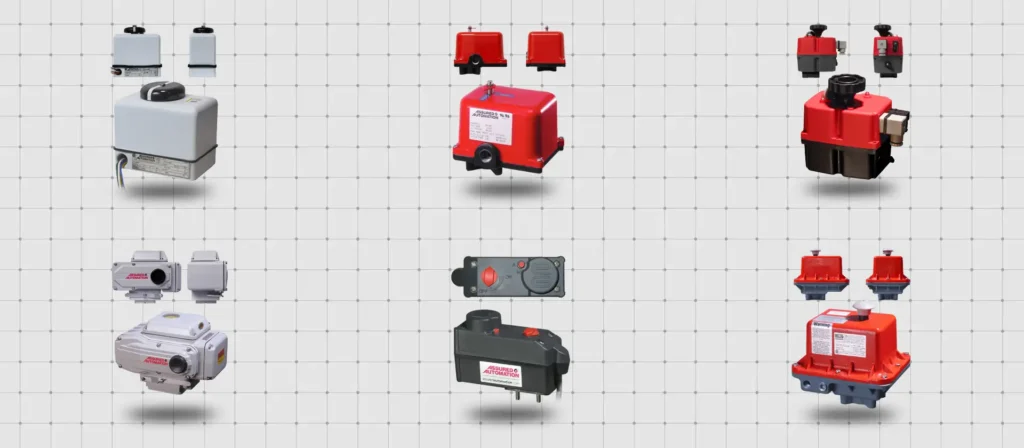
Assured Automation offers several electric valve actuators to meet different valve automation requirements.
The V4 Series is our compact, low-cost electric actuator with NEMA 4/4X housing, manual override, ISO 5211 direct mounting, and on/off operation.
The R Series provides a compact, cost-effective option for quarter-turn valve automation, with NEMA 4/4X weatherproof enclosure, ISO 5211 mounting, manual override, and on/off or modulating versions.
The S4 Series provides multi-voltage operation, auto-voltage sensing, manual override, visual position indication, ISO 5211 mounting, and options such as a modular positioner board and battery backup fail-safe module.
The K4 Series is designed for industrial-duty electric valve actuation. It includes features such as 90-degree travel, a NEMA 4/4X weatherproof enclosure, manual override, a visual position indicator, an ISO 5211 mounting pad, and a self-locking worm gear drive.
The CE Series is a compact electric actuator for smaller valve automation applications that require simple 90-degree operation, manual override, and visual position indication.
The B Series is designed for explosion-proof electric valve actuation, with NEMA 4/4X/7 enclosure options, manual override, visual open/closed indication, ISO mounting, and torque output up to 20,000 in/lbs.
The right choice depends on the application. A compact indoor valve may not need the same actuator as a larger outdoor valve. A general-purpose utility line may not need the same actuator as a classified hazardous area.
Avoid Making the Decision Based on Habit
Many valve actuation decisions are made based on what has been used before. That may be fine when the conditions are the same.
But many systems change over time.
Plants add remote equipment. OEMs build more compact skids. Utilities expand into areas without convenient air headers. Maintenance teams look for ways to reduce compressed air waste. Control systems become more digitally connected.
In those cases, electric valve automation warrants closer inspection.
It may reduce installation complexity. It may avoid the need to extend the compressed air line. It may provide the control and feedback needed without adding pneumatic accessories.
The key is to compare the complete system, not just the actuator.
Talk to a Valve Automation Expert Before Making the Switch
Electric valve automation may be a better choice when compressed air is unavailable, extending it is expensive, or it is unnecessary for the application. It can simplify installation and reduce the need for air lines, solenoids, and air preparation components.
Pneumatic actuation still has its place. It remains a strong choice for fast cycling, spring return fail-safe operation, and many industrial environments.
The right answer depends on your valve, process conditions, control requirements, and installation environment. Need help deciding between electric and pneumatic valve actuation? Contact the valve automation experts at Assured Automation. Our team can help you review your application and select the right actuator for your valve, control system, and operating conditions.