$
$ Search




 ,
,




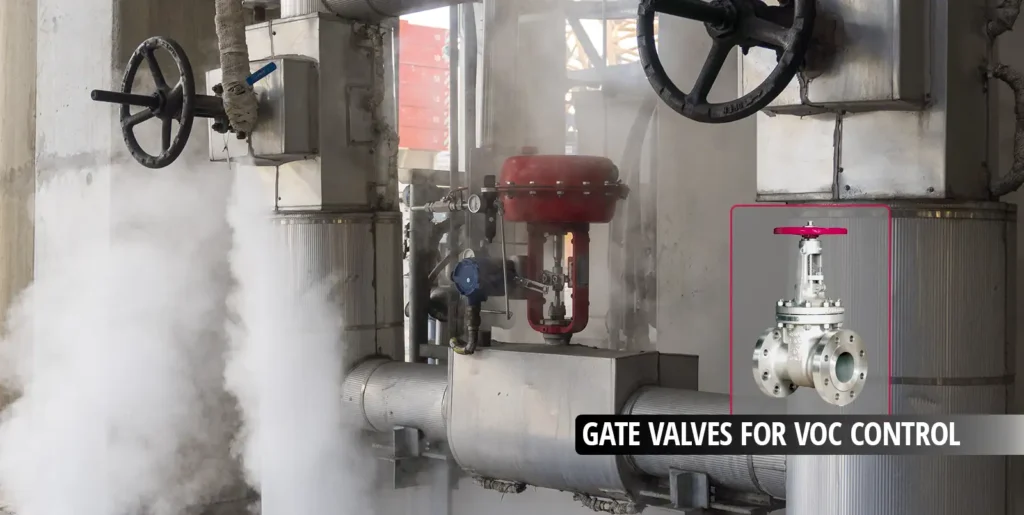
In refineries, chemical plants, and power generation facilities, low emission gate valves do more than just start and stop flow. They can also become potential leak points when handling volatile organic compounds, or VOCs. That makes valve selection an important part of a broader emissions-control strategy.
The EPA identifies leaking equipment, including valves, pumps, and connectors, as a major source of VOC and volatile hazardous air pollutant emissions in petroleum refineries and chemical manufacturing facilities.
In one EPA fugitive leaks best practices document, the agency notes that a typical refinery or chemical plant can emit hundreds of tons of VOCs per year from leaking equipment. Valves are specifically called out as one of the sources.
That is why low emission gate valves deserve careful consideration for demanding applications. When VOC leakage must be minimized, a standard gate valve may not meet the sealing performance required by plant standards, maintenance expectations, or leak detection and repair programs.
Assured Automation’s DSI-WG Series wedge gate valves are designed and manufactured to ensure leakage of less than 100 ppm of volatile organic compounds. That makes them a practical option for facilities where fugitive emissions are a concern.
Why VOC Leakage Matters in Gate Valve Selection
VOC leakage is not just an environmental issue. It can affect worker safety, regulatory compliance, maintenance costs, and the long-term reliability of plant operations. In facilities that operate leak detection and repair programs, leaking valves can trigger inspection, repair, retesting, and documentation requirements.
The challenge is that valves are everywhere in process plants. A single valve may seem like a small component, but the cumulative effect of valve leakage across a refinery or chemical plant can be significant. That is especially true in large facilities with thousands of valves, pumps, connectors, flanges, and other potential leak points.
Gate valves are commonly used for isolation service. They are not typically selected for throttling or flow modulation. Their job is usually straightforward: open fully or close fully. However, when the process media includes VOCs, the sealing performance of the valve becomes just as important as size, pressure rating, material of construction, and end connection.
This is where low emission valve design becomes valuable. It focuses attention on the stem sealing area, bonnet gasket, gland design, packing arrangement, and surface finishes that influence leakage performance.
Where Low Emission Gate Valves Are Commonly Used
Low emission gate valves are most relevant in applications where fugitive emissions are a known concern. That includes petroleum refining, chemical processing, petrochemical operations, power generation, and other demanding industrial environments.
These are not light-duty applications. They often involve higher pressures, elevated temperatures, hazardous media, strict plant specifications, and formal maintenance procedures. In these settings, the wrong valve selection can create problems that go well beyond the cost of a simple replacement.
We mention that the DSI-WG Series is listed on approved manufacturer lists (AMLs) of petroleum refineries, chemical processing plants, and power generation plants around the world. That matters because many large facilities do not allow just any valve into critical service. Approved manufacturer lists are often used to standardize quality, reduce risk, and simplify specification decisions.
For engineers, maintenance teams, and procurement professionals, AML acceptance can be an important factor. It helps narrow the field when selecting valves for demanding applications where performance history and compliance with plant standards matter.
What Makes the DSI-WG Series Suitable for Low Emission Service
The DSI-WG Series is a carbon steel, ANSI flanged, wedge gate valve. Its key differentiator is its low emission design (Less than 100 ppm).
It also separates the DSI-WG Series from commodity gate valves that may meet basic dimensional or pressure requirements but do not address fugitive emissions in the same way.
The DSI-WG Series includes several design features that support low emission performance. These features are listed as standard on the product page and datasheet, not as uncommon add-ons. That distinction is important because many facilities want consistency across installed valves, especially when they are managing emissions risk and maintenance expectations across a large operation.
Download our DSI-WG Series datasheet.
When to Specify DSI-WG Wedge Gate Valves
The DSI-WG Series is a good fit when an application requires a carbon steel wedge gate valve and fugitive emissions are a concern. That includes VOC service in refineries, chemical processing plants, power generation facilities, and similar industrial operations.
These valves are especially relevant when the application calls for on/off isolation rather than throttling. Gate valves are designed to operate fully open or fully closed. Using them for throttling can damage the gate or seat and reduce valve life. For flow control or modulation, a different valve type is usually more appropriate.
AML requirements are another reason to evaluate the DSI-WG Series. Many refineries, chemical plants, and power generation facilities rely on approved manufacturer lists to control risk. A valve that is already found on AMLs may simplify specification, purchasing, and project approval.
The DSI-WG wedge gate valves are also available in a broad range of sizes and pressure classes, making them suitable for many demanding plant applications. Final selection should always be based on the actual media, pressure, temperature, valve size, flange class, and site requirements.
Talk to Assured Automation’s Valve Experts
VOC leakage, pressure class, temperature limits, plant specifications, and approved manufacturer requirements all matter when selecting gate valves for refinery, chemical processing, and power generation applications.
Assured Automation’s valve experts can help you evaluate your application and identify the right DSI-WG Series gate valve configuration for your process. Whether you are replacing existing valves, specifying valves for a new project, or reviewing options for VOC service, the right technical guidance can help reduce risk and improve long-term performance.
Contact Assured Automation’s valve experts to discuss your application and get help selecting the right low emission gate valve.