$
$ Search




 ,
,




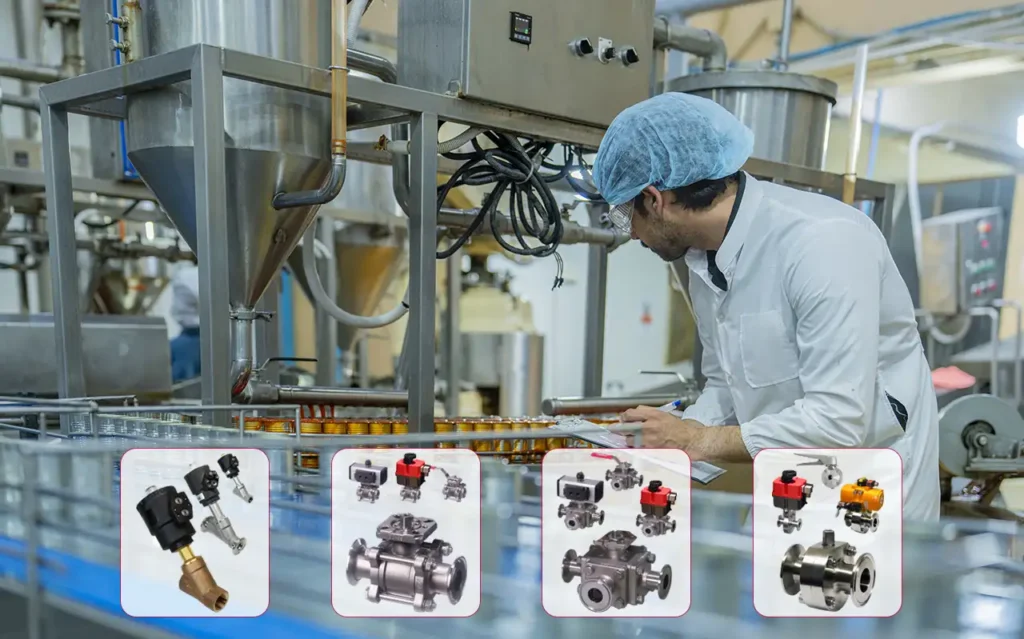
In any food or beverage production facility, clean-in-place (CIP) and sterilize-in-place (SIP) systems are nonnegotiable components of process integrity and safety. As you know, plants must maintain strict sanitation standards to comply with regulatory agencies and avoid product recalls, contamination events, or shutdowns. This is why automated valves in CIP and SIP play an essential role..
Given the stringent sanitation requirements of the FDA and USDA, food processors dedicate substantial time and resources to cleaning and sterilization—often representing a significant portion of each production day.
Because CIP and SIP protocols are so critical (and resource intensive), even modest improvements in their efficiency can yield meaningful gains in throughput, cost, and reliability.
In this post, we’ll explore how transitioning “from manual to smart” via automated valve systems can streamline cleaning cycles, support validation, reduce downtime, and enhance overall hygiene in food & beverage plants.
For a broader look at automation trends in food manufacturing, see our earlier blog, Automation in Human and Pet Food Production.
Understanding CIP & SIP: Fundamentals and Regulatory Context
Clean-in-Place (CIP)
CIP refers to the process by which equipment, piping, vessels, and associated components are cleaned internally—without disassembling or completely shutting down the system. Cleaning agents, rinses, and recirculation are used in sequence to remove product residues, biofilms, and soil. In food processing industries—dairy, brewing, sauces, beverages, etc.—CIP is foundational to maintaining food safety.
Sterilize-in-Place (SIP)
SIP typically follows a successful CIP sequence and uses steam or chemical sterilants at elevated temperature and pressure to kill residual microbes. In high-risk or aseptic processing environments, SIP cycles are essential to ensuring microbial control after cleaning.
Regulatory Standards and Hygienic Design Requirements
Food and beverage manufacturers must meet stringent cleaning and equipment design standards to ensure product safety and prevent contamination.
- FDA Current Good Manufacturing Practice (CGMP): Requires sanitary operations and validated cleaning procedures. (Source).
- USDA/FSIS Sanitation Standards: Mandate effective cleaning programs and documentation for meat and poultry plants. (Source).
- 3-A Sanitary & EHEDG Guidelines: Specify smooth, drainable, crevice-free designs for all product-contact components, including valves and fittings. (Source).
Together, these standards emphasize repeatability, traceability, and hygienic design—areas where manual valve operation can introduce variability or risk.
The Shift from Manual to Automated Valve Control
CIP and SIP systems in many food and beverage plants began as manual operations—technicians opened and closed valves, connected hoses, and monitored cycles by sight. While effective for small setups, manual cleaning often caused inconsistent results, longer downtime, and higher contamination risk.
Automation has changed that. Assured Automation’s full line of Food, Beverage & Pharmaceutical Valves and pneumatic or electric actuators can control valve sequencing precisely, ensuring each cycle runs as validated. Cleaning operations are faster, repeatable, and automatically documented for regulatory compliance.
Automation also improves safety—operators stay clear of hot steam and caustic agents while monitoring cycles remotely through control panels or HMIs.
How Automated Valves Improve CIP/SIP Efficiency and Hygiene
Automated valves are central to reducing cleaning time, improving hygiene, and ensuring repeatable results in CIP/SIP systems:
- Precision Control: Maintain correct flow, temperature, and chemical concentration—reducing overcleaning and resource waste.
- Shorter Downtime: Automatic sequencing speeds up batch changeovers and increases equipment availability.
- Hygienic Design: 316L stainless steel construction, polished internals, and FDA-approved seals minimize residue buildup and bacterial growth.
- Safety and Reliability: Fail-safe actuators and position sensors maintain control and verification during every cycle.
- Traceability: Automated logs support FDA and GMP documentation and cleaning validation.
- Easy Integration: Modular valve manifolds simplify installation and maintenance while fitting into existing control systems.
Measurable Benefits of Valve Automation in CIP/SIP
By automating valve control and validation, plants not only improve cleaning efficiency but also simplify compliance with FDA, GMP, and 3-A Sanitary standards. The measurable benefits go well beyond faster cleaning cycles:
- Reduced Cleaning Time: Automated sequencing minimizes idle time between batches, improving overall line throughput.
- Lower Utility and Chemical Costs: Optimized flow and timing reduce consumption of water, energy, and cleaning agents.
- Higher Uptime: Faster cleaning and sterilization cycles keep production running longer between shutdowns.
- Improved Safety: Automation limits operator exposure to hot steam and caustic cleaning solutions.
- Consistent, Documented Results: Every cleaning cycle is automatically logged and traceable, supporting internal QA and audit readiness.
Applications Across the Food & Beverage Sector
Automated valve systems are now used across a wide range of food and beverage applications where hygiene and speed are critical:
- Dairy processing: Frequent cleaning cycles for milk, yogurt, and cheese lines.
- Breweries and beverage plants: Rapid batch changeovers between flavors and formulations.
- Sauces, condiments, and prepared foods: Viscous products that require reliable cleaning of lines and heat exchangers.
- Pharmaceutical and nutraceutical facilities: Sterile processes that demand both CIP and SIP validation.
Assured Automation offers a range of sanitary ball valves, butterfly valves, and pneumatic actuators engineered for these environments. See our Food, Beverage & Pharmaceutical Valves for details.
Key Takeaways:
- Automated valves enhance cleaning consistency, hygiene, and compliance.
- Plants benefit from shorter cleaning cycles and greater production uptime.
- Automation reduces utility costs and minimizes operator exposure.
- FDA, GMP, and 3-A standards are easier to meet and document.
- Modern valve systems provide a clear path from manual to smart cleaning operations.
Contact Assured Automation to discuss valve automation solutions that improve cleaning efficiency, support regulatory compliance, and keep your plant running safely and reliably.
Explore our Food, Beverage & Pharmaceutical valve lineup or speak directly with our experts for application-specific guidance. Our capabilities extend far beyond these standard “off-the-shelf” valves. In fact, a large portion of our business is providing custom assemblies and large projects in these and other industries.